Whether it's a diesel power station in Fujairah, a gas turbine plant in Abu Dhabi, or an industrial generator complex in Duqm — the expectation is simple. It runs. All day. Every day.
But behind that reliability sits a component that rarely gets the attention it deserves — the turbocharger. And in 2026, with power demand across UAE and Oman continuing to grow and maintenance budgets under pressure, a neglected turbocharger is one of the most common reasons a power plant underperforms or goes offline unexpectedly.
This blog breaks down why turbocharger maintenance matters specifically for power plants, what the warning signs look like, and what a proper service actually involves.
Why Power Plant Turbochargers Are Different
Most people associate turbochargers with ships or trucks. But diesel and gas-powered generators and power plants use them too, and the demands placed on a power plant turbocharger are in some ways more severe than anything in the marine world.
Here's why:
- Continuous operation. A ship's engine gets rest time in port. A power plant turbocharger runs continuously sometimes 8,000 hours before a scheduled maintenance window even comes around. That's nearly a full year of non-stop operation.
- Consistent high load. Power plants typically run at steady, high load rather than varying speeds. This sounds easier on equipment, but it means heat accumulates constantly with no cool-down periods to give components a break.
- Consequences offailure are immediate. If a turbocharger fails on a power plant, the generator output drops or the unit trips entirely. In a region where summer temperatures regularly exceed 45°C and air conditioning is not optional, an unplanned outage is a serious problem commercially, operationally, and in some cases, safety-wise.
This is why turbocharger maintenance for power plants in UAE and Oman is not a boxticking exercise. It is a direct operational and business priority.
What Happens When a Power Plant Turbocharger Degrades
Turbocharger degradation in a power plant doesn't look dramatic at first. It's gradual, and it usually shows up in three ways:
-
Rising fuel consumption. As turbocharger efficiency drops, the engine needs more fuel to produce the same output. For a plant running around the clock, a 3–5% rise in fuel consumption adds up to a significant cost over a year often far more than the cost of a timely service.
- Reduced output capacity. A degraded turbocharger delivers less compressed air to the engine, reducing how much power the unit can generate at full load. In peak summer months when demand spikes, this reduced headroom can be the difference between keeping up with load and falling short.
- Increased wear across the engine. Incomplete combustion caused by insufficient boost pressure puts stress on pistons, valves, and cylinder liners. The turbocharger problem becomes an engine problem and engine problems are significantly more expensive to fix.
The Most Common Turbocharger Problems in Power Plant
After years of working with power generation clients across UAE and Oman, these are the issues we see most regularly:
- Fouled compressor and turbine blades. Dust, particulates, and combustion residue build up on the blade surfaces over time. In UAE and Oman, where fine desert dust is constantly in the air — this happens faster than in many other environments. Fouled blades reduce aerodynamic efficiency and starve the engine of the air it needs.
- Bearing wear from extended run hours. Power plant turbochargers running continuously between maintenance windows accumulate bearing wear steadily. When bearing clearances open beyond tolerance, boost pressure drops and rotor stability decreases — increasing the risk of a sudden failure.
- Seal and oil system deterioration. Oil seals degrade under continuous heat exposure. When they go, oil enters the air or exhaust stream, creating deposits on turbine surfaces and contributing to black exhaust smoke that signals incomplete combustion.
-
Nozzle ring erosion. In plants running on heavy fuel or lower-grade diesel, nozzle ring erosion is a common finding. It changes the flow dynamics inside the turbine and directly affects performance.
Each of these is far cheaper to fix proactively than reactively.
What a Proper Power Plant Turbocharger Service Covers
A professional turbocharger overhaul for a power plant is more than a clean and inspect. Here is what a complete service involves:
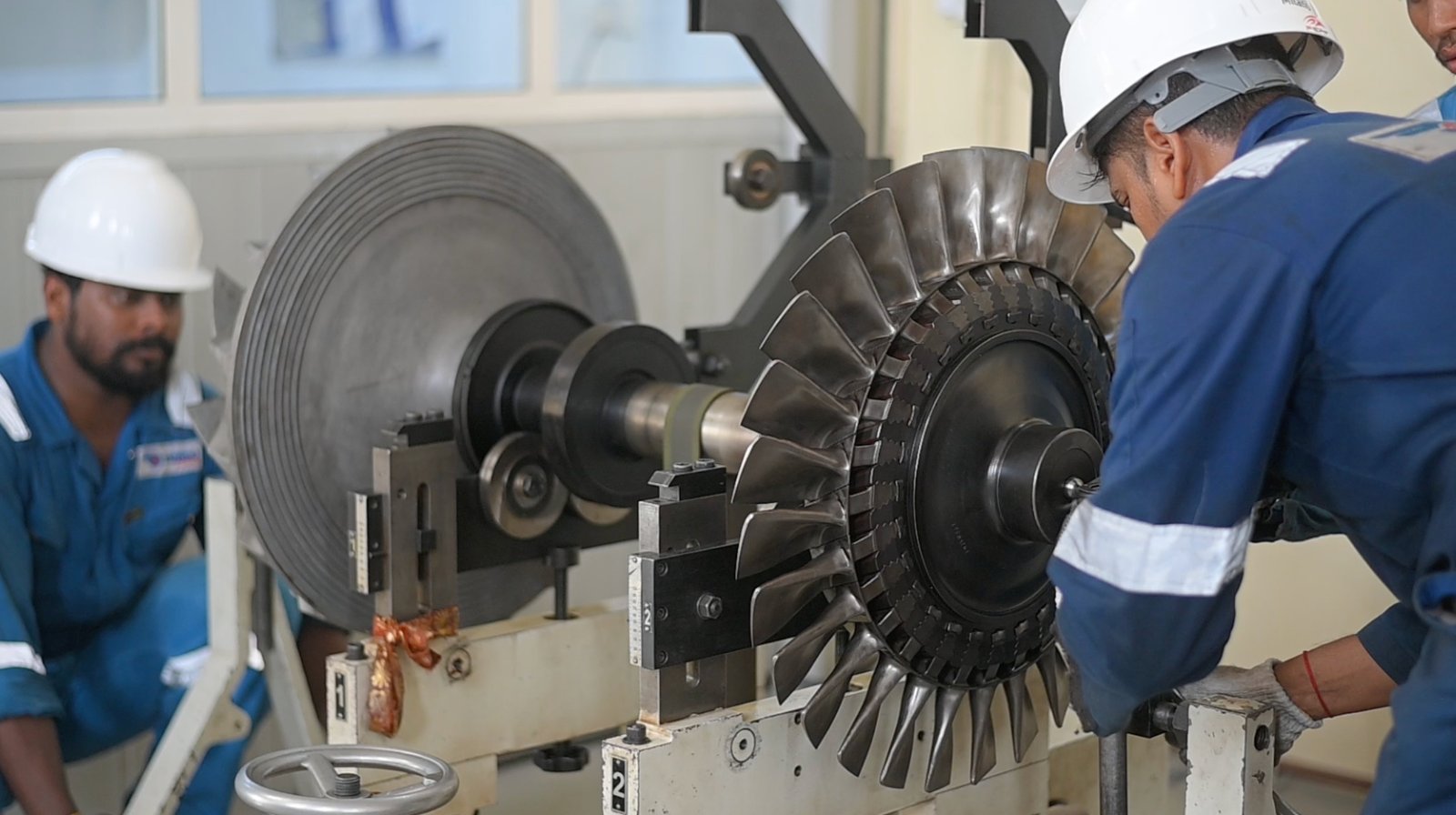
- Full disassembly and measurement. Every component is measured against OEM tolerance tables. Clearances are checked, recorded, and compared against the manufacturer's specification.
- Compressor and turbine cleaning. Blade surfaces are professionally cleaned to restore aerodynamic efficiency. For plants in UAE and Oman, this alone often produces a measurable improvement in output and fuel consumption immediately after service.
- Bearing replacement. Journal and thrust bearings are replaced as standard during a full overhaul, not assessed and reused. Bearings are consumable components and treating them as such is the right approach for a plant running at continuous load.
- Seal and gasket renewal. All seals and gaskets are replaced with genuine or OEMequivalent components, preventing oil contamination issues after service.
- Nozzle ring inspection and replacement if required. Nozzle rings are inspected for erosion and replaced if measurements are outside tolerance.
- Reassembly, balancing, and testing. The unit is reassembled, dynamically balanced, and tested before being returned to service. A signed service report with before-andafter measurements is issued for your maintenance records.
For power plants that cannot afford to take a unit fully offline, our on-site service team can complete the overhaul at your facility minimising downtime and avoiding the need to transport the unit to a workshop.
Turbocharger Maintenance for Power Plants in Oman
Oman's power generation sector — particularly in Duqm, Salalah, and across the interior presents specific challenges. Distance from major service hubs, extreme ambient temperatures, and the demanding nature of desert operation all accelerate turbocharger wear compared to more temperate environments.
Our Oman team operates from Duqm and provides on-site service across the country. We carry turbocharger spare parts for the most common power generation brands in local stock, reducing lead times significantly compared to ordering from overseas. For power plant operators in Oman managing tight maintenance windows, having a regional specialist on the ground makes a genuine operational difference.
When to Schedule Your Next Service
A practical guide for power plant operators:
- Every 8,000 hours — minimum inspection interval for most power generation turbochargers.
- Every 16,000 hours — full overhaul recommended for most units under normal operating conditions.
- Immediately — if you are seeing rising fuel consumption, reduced output, unusual noise, or exhaust smoke.
Do not wait for a failure. In a power plant environment, an unplanned turbocharger failure means unplanned downtime — and unplanned downtime in UAE or Oman summer conditions is a problem nobody wants to face.
How Turbo Power Engineering Supports Power Plants
At Turbo Power Engineering, we have been supporting power generation operators across UAE and Oman since 2016. We have the technical depth, parts inventory, and on-site capability to service power plant turbochargers across all major brands.
Brands we service: ABB, MAN, Napier, MET, IHI, KBB, Mitsubishi and more.
- On-site turbocharger service at your power plant — UAE and Oman.
- Full workshop overhaul at Fujairah and Dubai Maritime City.
- Genuine and OEM-equivalent turbocharger spare parts in local stock.
- 24/7 emergency response for unplanned failures.
Detailed service documentation for maintenance records and audits.
Talk to Our Team
If your power plant turbochargers are approaching service interval or if you are already seeing the signs of degradation — get in touch now. Our team will assess your situation and recommend the most practical, cost-effective solution.
* Fujairah: Al Hayl Industrial Area, PO Box 4338 * Dubai: W-347, Dubai Maritime City * Oman — Duqm: +968 7900 6197 * India — Mumbai: +91 98200 47258 * Singapore
+971 505208053 (24/7 Emergency) +971 92223600 * info@turbopowereng.com * turbopowereng.com/services